
Impact damage and an off-track condition are not the same diagnosis
A collision can displace a door, but an off-track photograph does not establish that a collision caused it. Worn or damaged rollers, connections, cables and track supports also need consideration. This guide incorporates the former bent-track and stuck-open booking articles so the safety response and inspection questions are in one place.
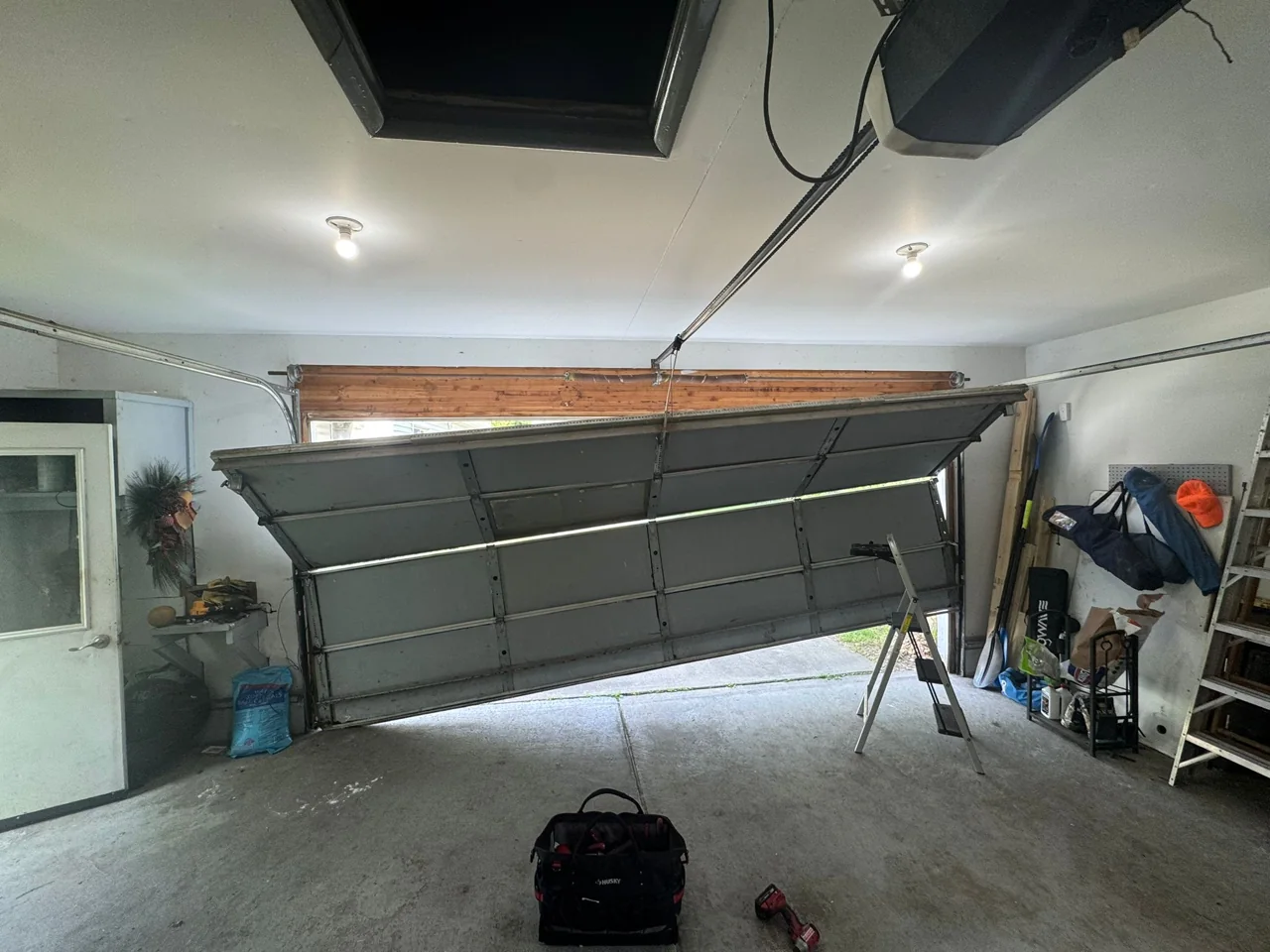
The photo shows an off-track condition documented at a Broomfield job in November 2025. It is a before-repair condition image. We do not attribute that particular failure to a vehicle or to neglected maintenance without the job findings. Use it to understand why a tilted door should not be treated as a simple remote-control fault.
What each visible symptom can and cannot tell you
| Visible condition | Useful information | What still needs inspection |
|---|---|---|
| Creased section | Location and extent of visible deformation | Section connections, mounting and compatible replacement availability |
| Roller outside its track | The assembled door is not travelling normally | Roller, hinge, track geometry and the underlying cause |
| One side higher than the other | Uneven door position | Cable and counterbalance system, supports and related damage |
| Door remains open | Security and access concern | Whether the system is safely supported and why normal closure failed |
Do not hammer a track, press a panel straight, pull cables or remove a roller to test one of these possibilities. Taking the door apart changes the way its weight is supported. Springs and associated hardware can remain loaded even when the opener has no power.
A service-call note you can use
Provide the city, whether the door is fully or partly open, what happened immediately before the failure, and whether a vehicle is trapped. Add a safe photo of the whole opening rather than only the damaged corner. Mention alternate entry and any restriction that affects access to the work area. No access code is needed in a public message.
If you know a vehicle hit the door, say whether it was stationary or moving at the time. If you do not know the cause, report the condition without guessing. Do not run another cycle just to reproduce the event. Keep people and pets clear, and avoid walking under unsupported equipment to move belongings.
After the system is secured
Ask for the cause and the proposed repairs to be explained separately. A replacement roller may address one damaged component but not a bent track, and a new section may not repair its support connections. Obtain the included parts, any remaining damage and operating checks in writing.
Compare off-track repair with replacement options only after inspection. Insurance coverage belongs to your insurer and policy; the article and photo do not establish a covered claim.
After a vehicle strikes a garage door, the largest dent is only one part of the assessment. Tracks, hinges, rollers and connections may also be affected. The immediate priority is to keep people away from unstable equipment, not to see whether the motor can push the door through its travel.
Stop operation when the door is displaced
Do not cycle a tilted, off-track or visibly unstable door. Do not stand beneath it, push the sections back into place or loosen cables and bottom brackets. Keep the area clear while arranging qualified inspection.
If the door is stuck open, explain its position when calling. Do not pull a release cord to experiment with a damaged or unsupported door.
Collect information without moving the equipment
Take photographs from a safe location of the full opening and visible damage. Note whether the door was closed or moving when the impact occurred, whether a vehicle is blocked and whether you have another entry. A label photo is helpful only if it can be taken without climbing or approaching unstable hardware.
Ask for a system assessment
The technician should consider more than the visible section: track alignment, mounting points, roller and hinge condition, neighboring joints and the opener connection are relevant questions. A dented section may or may not be replaceable with a compatible part.
Ask whether a section-replacement proposal addresses all observed damage. If a full-door alternative is suggested, request the reasons and compare the included work rather than assuming a complete replacement is mandatory after every bump.
Separate repair planning from insurance decisions
Keep your photographs and written estimate for your records. Ask your insurer directly about your own policy and any claim requirements; this guide cannot establish coverage. Confirm the repair scope, availability of compatible sections and access arrangements for your Denver metro address.
If the repair changes the exterior appearance, check applicable property requirements before ordering. Avoid further operation merely to collect a video for the claim.
Frequently asked question
Does a small dent mean the door is safe?
Not by appearance alone. Changes in movement or displaced hardware need assessment even when the dent looks minor.
Discuss your garage door with Bolt
Tell us your Denver metro city, the equipment you have and the issue or project you are planning. Ask about current inspection and appointment options.
Call 720-500-7199Related help and manufacturer information
Related homeowner guide · Denver metro service areas · Lakewood garage door service
DASMA garage door system safety. Use the instructions for your exact equipment; this article is not a replacement for its manual.